
Niagara County Deed Records
Niagara County deed records are maintained by the County Clerk's Office in Lockport, the county seat. All deeds, mortgages, lis pendens, easements, and other real property documents for land in western New York's Niagara frontier are filed here. The office serves as the official recording authority and keeps comprehensive records for every town and city in the county. Property owners, title companies, and attorneys use these records daily to verify ownership and check for liens.
Niagara County Quick Facts
Niagara County Clerk's Office
The Niagara County Clerk's Office serves as the official recording office for all real property documents in the county. The Clerk records deeds and property transfers, mortgages and mortgage satisfactions, lis pendens and foreclosure notices, easements and right-of-way agreements, UCC filings that affect real property, and various other documents tied to real estate titles.
The office is in Lockport. Standard hours are Monday through Friday during regular business hours. Walk-in visits are welcome for both recording and searching. Staff will examine your documents for recording requirements, though they do not determine legal sufficiency. For legal questions about your deed, consult an attorney.
How to Search Niagara County Deed Records
In-person searches at the Clerk's Office in Lockport give you the most complete access to Niagara County deed records. The office maintains grantor and grantee indexes. You can look up transactions by party name or by the property's tax map information. Staff can help you locate the correct book and page for any recorded document.
For online access, the New York State Municipal Data Portal offers property sales data through Sales Web. This tool uses RP-5217 data to show 10 years of transfers across Niagara County. You can filter by town, school district, date range, or property type. It is a good starting point, though it does not replace a full title search at the Clerk's Office.
The New York State Archives holds historical documents that may supplement county records. For older deeds, surveys, and land grants, the Archives can be a useful secondary source.
Recording Deed Documents in Niagara County
Niagara County follows New York Real Property Law for all deed recordings. Documents must have original signatures properly acknowledged before a notary public. Every deed needs a complete legal description of the property, the names and addresses of all grantors and grantees, and the tax map parcel number.
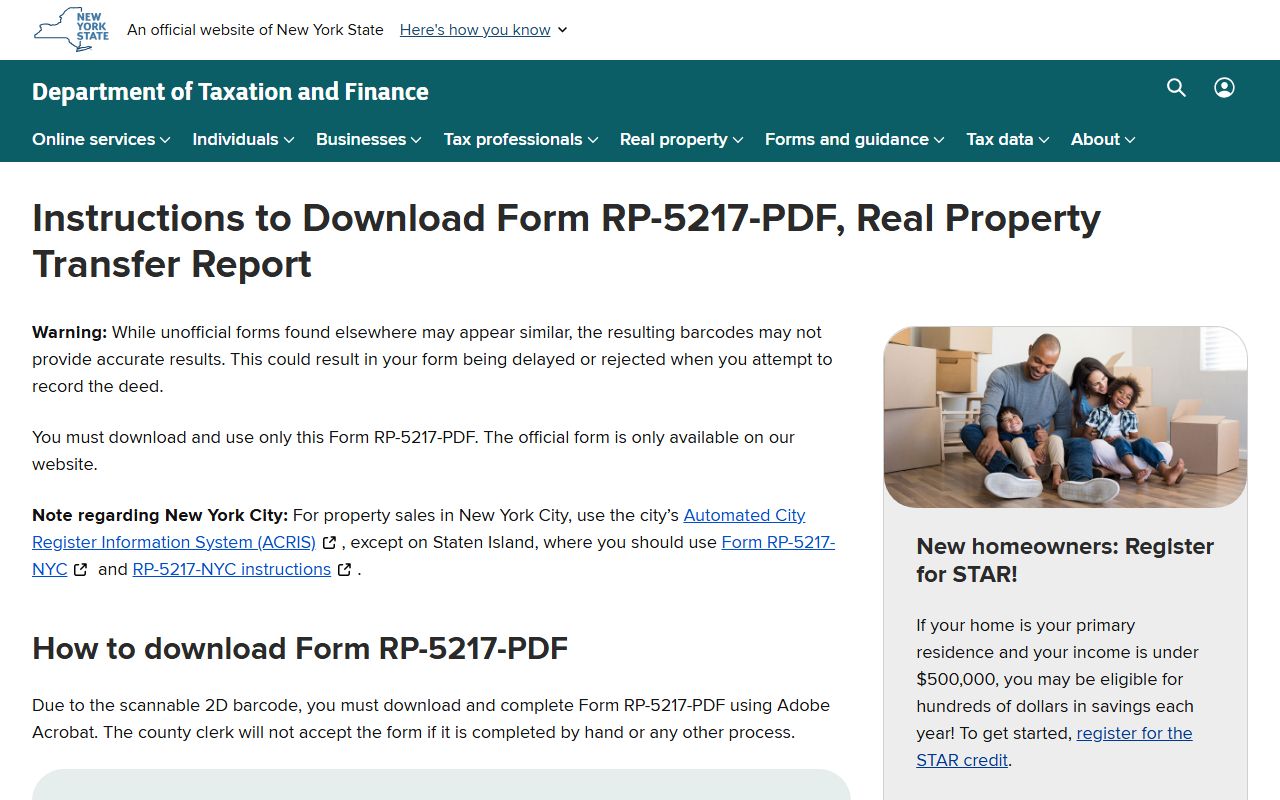
Two state forms must accompany every deed. Form RP-5217 captures the sale price, assessed value, and property use code. It must be completed in Adobe Acrobat because it contains a scannable barcode. The TP-584 transfer tax affidavit documents the transfer tax owed. Both forms are required before the clerk will accept the deed for recording.
Recording fees as set by state law and county resolution apply. The base fee covers the first page, with additional per-page charges. Confirm current amounts with the office before you file.
Transfer Tax and Mortgage Tax
The real estate transfer tax in New York is $2 per $500 of consideration. Sales of $1 million or more face an extra 1% mansion tax on residential properties. These amounts are paid at the Clerk's Office when the deed is recorded.
Mortgage recording tax is due when a mortgage is filed. The basic rate is 50 cents per $100 of mortgage debt. Additional state and county components apply. Niagara County is not in the Metropolitan Commuter Transportation District, so the MCTD surcharge does not affect filings here. Form MT-15 lists the exact rate breakdown for every county in the state.
For residential properties with one or two family units, the first $10,000 of the mortgage is exempt from the additional tax portion. This reduces the total tax slightly on smaller mortgages.
Property Assessment Records
Niagara County's Real Property Tax Service Agency maintains assessment rolls, tax maps, and property classification data. These records show the current owner, assessed value, and lot boundaries for each parcel. While assessment records are separate from deed records, they can help you find the information you need to search for a deed at the Clerk's Office.
The Municipal Data Portal provides equalization rates for Niagara County towns. These rates show how each municipality's assessment level compares to full market value. Understanding equalization rates matters when property taxes get split across jurisdictions like school districts and the county.
Legal Resources
New York Real Property Law sets the standards for deed preparation and recording. A deed must be in writing, signed, and acknowledged. Recording with the county clerk provides constructive notice to the public. Without recording, a later buyer who files first could claim priority. Prompt recording after closing is standard practice.
Free access to New York statutes is available through the Cornell Legal Information Institute. You can look up the Real Property Law and the Real Property Actions and Proceedings Law there. The New York State Senate legislation page shows pending bills that may change recording requirements in future legislative sessions.
Document Format Under NY Real Property Law
New York Real Property Law sets strict format rules for recorded documents. Paper size must be 8.5 by 11 inches. Use black ink on white paper. Margins need to be at least one inch on all sides. The top of the first page must have a three-inch blank space for the clerk's recording stamp. If your document does not meet these standards, the clerk may still record it but will charge a non-conforming fee. Getting the format right before you file saves time and money.
Towns and Cities in Niagara County
Niagara County includes the cities of Lockport, Niagara Falls, and North Tonawanda, along with several towns. All deed records for every community in the county are filed with the Niagara County Clerk in Lockport. The towns include Cambria, Hartland, Lewiston, Newfane, Pendleton, Porter, Royalton, Somerset, Wheatfield, and Wilson. No cities in the county meet the population threshold for a separate page on this site.
Nearby Counties
Niagara County borders Erie County to the south and Orleans County to the east: